
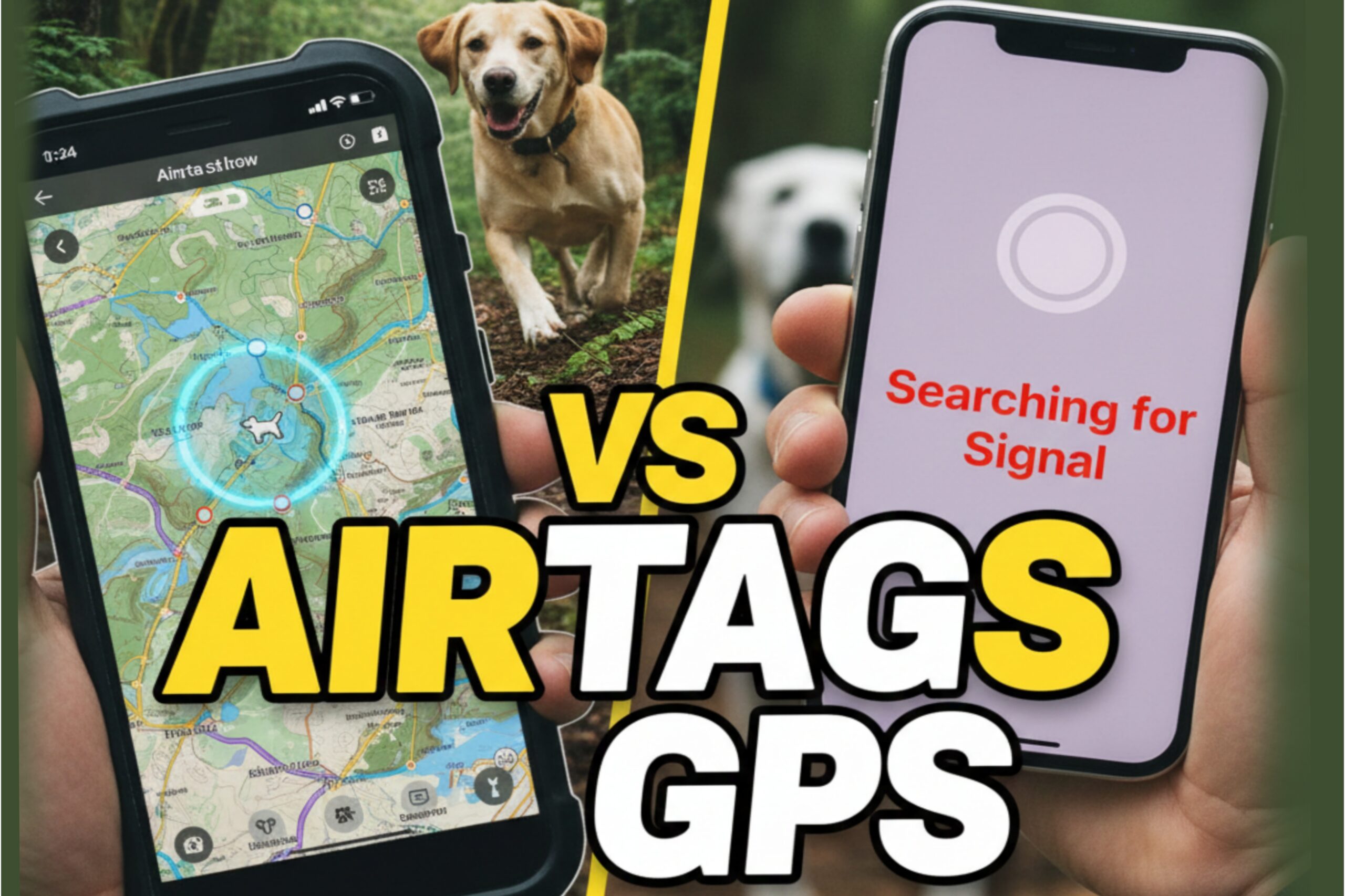
Why I Stopped Using AirTags on My Dog (And Why You Should Too)
If you’re reading this, you probably love your dog enough to be worried. Maybe you’re like I was a year ago—scrolling through Amazon, looking at those cute $10 AirTag collar holders and thinking, “Thirty bucks to never lose my dog? Done deal.” In the USA, we’ve been sold this idea that an Apple AirTag is a safety device for everything. And for your keys or your luggage? It’s magic. But after a terrifying Tuesday evening involving a slipped fence and a silent “Find My” app, I realized I was betting my dog’s life on a keychain finder.
Here’s the truth about the AirTag vs. GPS debate. No sugarcoating, just the real-world stuff you need to know to keep your pup from becoming a “Missing Dog” poster.
The Panic Moment: When “Find My” Goes Dark
Let’s talk about how AirTags actually work. They don’t have a GPS chip. They don’t talk to satellites. They are essentially little Bluetooth “beepers” that wait for a passing iPhone to notice them.
Last summer, my neighbor’s Beagle, Cooper, got spooked by a delivery truck and cleared the gate. Cooper had an AirTag. We opened the app, and it said he was “At Home.” Why? Because the tag was still talking to my neighbor’s phone in the kitchen.
Ten minutes later, it updated to a spot three streets over. We ran there. Nothing. The tag had pinged off a random person’s phone as they drove past Cooper, but by the time we got the notification, he was already long gone.
This is the “Ghost Ping” problem. If your dog is moving, an AirTag is always ten steps behind. If your dog runs into a park, a wooded lot, or a quiet street at 11 PM, there are no iPhones around to find him. He’s essentially invisible.
Why a Real GPS Tracker (Like Tractive or Fi) is Different
When I finally switched to a dedicated GPS tracker (I use the Tractive DOG 6), the difference was night and day.
The Satellite Advantage
A real GPS tracker is like a miniature cell phone for your dog. It talks directly to satellites. It doesn’t need a neighbor to walk by with an iPhone. Whether your dog is in a cornfield or hiding under someone’s porch, the collar sends its own signal to your phone.
Live Tracking: The Blue Dot
If you’ve ever tried to find a moving dog with an AirTag, you know the frustration. With a [Tractive DOG 6], you hit a button called “LIVE Mode.” Suddenly, you see a blue dot on your map that updates every 2 to 3 seconds. You can literally watch which way your dog turns. It turns a “search and rescue” into a “go and pick up.“

[Buy Now: Tractive GPS Dog 6 – Real-Time Satellite Tracking]
The “Silent Killer”: Why Vets Hate AirTags
This is the part most people don’t talk about. AirTags are small, smooth, and—to a dog—they look exactly like a treat.
I spoke with a vet in Virginia who told me they’ve seen a massive spike in emergency surgeries for “AirTag Ingestion.” Dogs chew them off the flimsy silicone holders and swallow them.

-
The Danger: It’s not just a choking hazard. It’s the lithium battery. If your dog’s stomach acid pierces that battery, it’s a life-threatening emergency.
-
The Cost: An AirTag is $29. The surgery to “fish it out” of your dog’s stomach can cost $3,000 to $5,000.
Dedicated collars like the [Fi Series 3] are built into a stainless steel frame. They are part of the collar, not a dangling toy. They are bite-proof, mud-proof, and designed to survive a dog being a dog.

[Buy Now: Fi Series 3 Smart Collar – Link ]
Let’s Talk About the “Monthly Fee” (Is it a Scam?)
I get it. Nobody wants another monthly subscription. We already pay for Netflix, Spotify, and gym memberships we don’t use.
But here’s how I look at the $8–$12 a month for a GPS tracker: It’s “Bail Money.” If your dog gets lost, you’re going to spend $200 on reward posters. You’re going to pay $150 to get them back from the animal shelter. You might spend thousands at the emergency vet if they get hit by a car while wandering.
For the price of two Starbucks coffees a month, you ensure that if your gate blows open at 2 AM, you’ll get an alert on your phone before the dog even reaches the end of the block. That’s not a “subscription”—that’s peace of mind.
2026 Tech: Your Dog’s New Health Monitor
Heading into 2026, these collars have become incredibly smart. They aren’t just for when the dog gets lost.
-
Sleep Tracking: My Tractive app told me my dog was restless all night. Turns out, he had a flea allergy I hadn’t noticed yet.
-
Bark Monitoring: The new DOG 6 actually tracks how much your dog barks while you’re at work. It helped me realize my dog had separation anxiety that I needed to address.
-
Fitness Goals: It’s like an Apple Watch for pups. You can see if your dog walker is actually walking the dog or just sitting on a bench.
The Quick Guide: Which One Should You Buy?
I’ve tested a lot of these. Here is my honest recommendation:
FAQs (Real Questions I Get Asked)
Q: “Won’t the GPS be too heavy for my small dog?” A: In 2026, no. The Tractive Mini and Fi Series 3 are now light enough for a 10lb Pug or Terrier. If your dog is under 5lbs (like a tiny Chihuahua), stick to a microchip and stay on a leash.
Q: “Does it work in the rain?” A: AirTags are “water-resistant.” My dog’s Tractive has been through lakes, mud pits, and snowstorms. It’s still ticking. If your dog loves the water, you need a real GPS.
Q: “Can I just use a microchip?” A: A microchip is like a return address on a letter—it only works after someone finds your dog and takes them to a vet. A GPS tracker lets you go get your dog. You need both.
The Verdict: Your Dog Deserves Better Than a Keychain
At the end of the day, we spend so much on high-quality kibble, fancy toys, and memory foam beds. Why would we settle for a “key finder” when it comes to their safety?
If you live in the USA—where we have big yards, fast roads, and plenty of places for a dog to hide—an AirTag is a false sense of security. It feels good until the moment you actually need it.
Don’t wait for the day you’re walking the neighborhood with a flashlight and a heavy heart. Get a real tool for the job.
-
Buy Link 1:
Get 20% Off Tractive GPS Dog 6 -
Buy Link 2:
Claim Your Fi Series 3 Membership Deal
What about you? Has your dog ever pulled a disappearing act? Drop a comment below—I’d love to hear which tracker (or lucky break) brought them home.

Pankaj | Founder & Lead Pet Tech Specialist
Hi, I’m Pankaj. I’m a pet travel enthusiast and a tech geek who believes our four-legged friends deserve the best gear available. I started PetOfParadise to cut through the marketing noise and provide pet parents with honest, data-driven reviews. From testing GPS collar signal strength to measuring airline-approved carriers, I personally oversee the testing of every product we recommend. My mission is to ensure that your next pet tech purchase is a smart one, focusing on safety, durability, and practical value.
Hey! Heard about bet917login? It’s got some decent odds and a pretty smooth interface. I’d say give it a shot, you might just get lucky! Check it out here: bet917login